
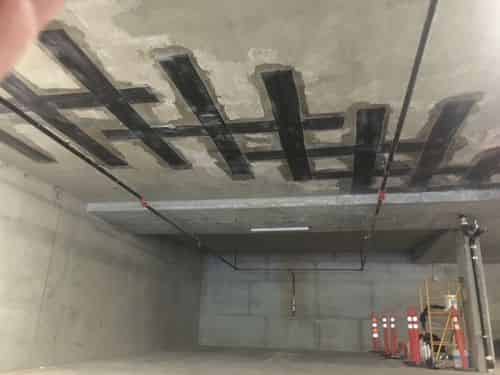
Tensile capacity
High-strength carbon or glass fibers carry tension the existing section cannot.
Externally bonded carbon and glass fiber strengthening for reinforced concrete and masonry, statewide across California. We install the Henkel and LOCTITE Tyfo certified system from engineer-of-record drawings, adding tensile capacity, confinement, and ductility without adding meaningful mass.
What FRP is
Fiber reinforced polymer is a composite of high-strength fibers in a polymer matrix. Bonded to an existing structure, it does structural work without changing how the building feels or weighs.
Fiber reinforced polymer is a composite of high-strength fibers, carbon or glass, embedded in a polymer matrix. Externally bonded to existing reinforced concrete and masonry, FRP adds tensile capacity, confinement, and ductility without adding meaningful mass to the structure.
FRP fabric is saturated with epoxy and bonded to a prepared substrate. Under load, tensile stress transfers through the bond into the fibers. In confinement applications, hoop-direction fibers restrain lateral expansion of the concrete core, increasing axial capacity and displacement ductility.
What it adds
Engineers reach for FRP because a thin bonded laminate can deliver capacity the existing section was never detailed for.
High-strength carbon or glass fibers carry tension the existing section cannot.
Hoop-direction fibers restrain the concrete core for higher axial capacity.
Members deform under cyclic seismic load instead of failing brittle.
A thin externally bonded laminate with no meaningful added mass.
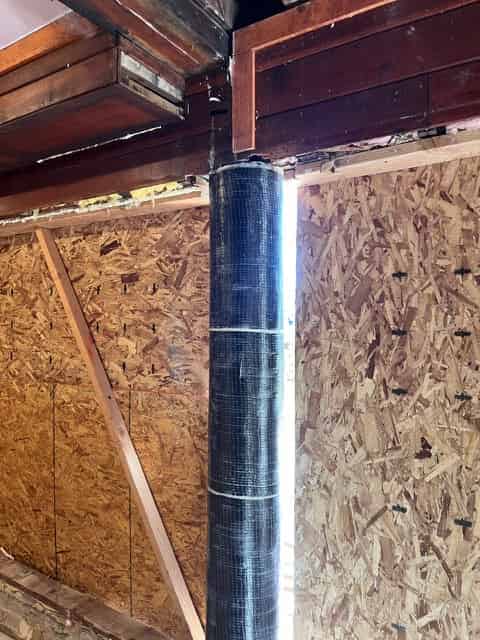
Low added mass
The finished laminate is roughly an eighth to a quarter inch thick. Compared with a concrete or steel jacket it adds almost no dead load, which is one of the reasons structural engineers specify it on existing buildings rather than rebuilding members.
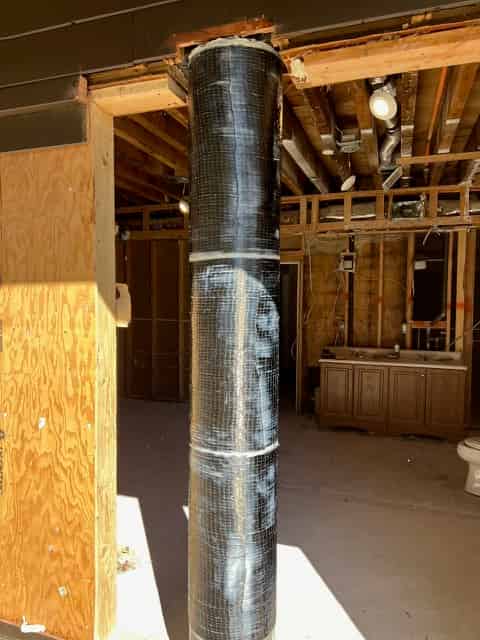
How it carries load
Older concrete frames carry structural debt: under-detailed joints, widely spaced ties, lap splices that were never meant for today’s seismic demand.
FRP fabric is saturated with epoxy and bonded to a prepared substrate. Under load, tensile stress transfers through the bond into the fibers. In confinement applications, hoop-direction fibers restrain lateral expansion of the concrete core, increasing axial capacity and displacement ductility.
That is how a retrofit closes the gap between what an existing member can deliver and what an ASCE 41 evaluation or a code-triggered upgrade now requires, targeted to the specific members the engineer flags, not the whole structure.
FRP retrofit, by member
The fabric, orientation, and anchorage change with the deficiency. These are the applications we install most across concrete and masonry.
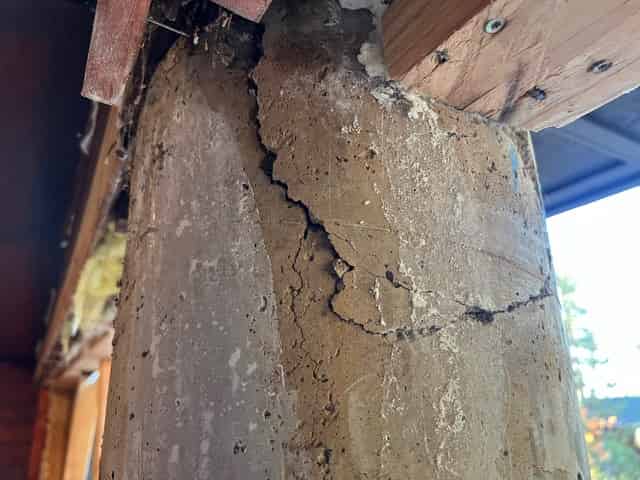
Confines the concrete core so it can carry more axial load and deform without losing capacity, while restraining lap-splice failure in older, lightly detailed columns.
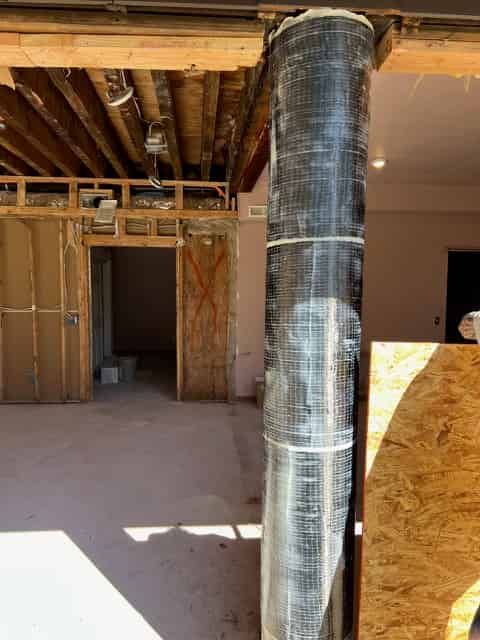
Adds shear capacity and confinement at the joint region of non-ductile moment frames, addressing a common deficiency identified during a seismic evaluation.
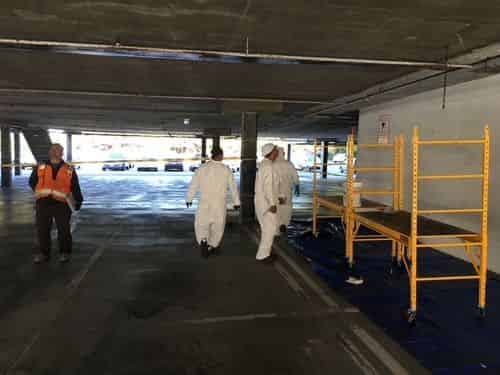
Supplies additional shear reinforcement to beams, columns, and walls when transverse steel is insufficient for current loads or revised seismic demand.
Increases bending capacity by adding externally bonded tensile reinforcement to the tension face of flexural members.

Strengthens unreinforced masonry to resist in-plane and out-of-plane seismic demand, a common requirement of California URM retrofit ordinances.
Engineering first, hands behind it
The design is written by other engineers. We are the licensed applicator: we read the package, bid it, install it, and document it.
Structural engineer of record issues drawings: members, demand, target capacity, performance objective, anchor calls.
Fyfe Engineering, on the materials side, works with the engineer of record to produce application-specific drawings off the EOR documents: fabric, orientation, layers, overlap, anchorage.
We issue a written, itemized bid with materials, labor, schedule, and assumptions. On award, we mobilize and execute surface preparation.
Primer, fabric, saturant, anchorage. Cure verification. QA documentation. Sign-off and handover, including warranty paperwork where applicable.
Standards and references
FRP is designed and installed against a specific set of structural standards and an evaluation report the building official can review.
ACI 440.2R-17Guide for the Design and Construction of Externally Bonded FRP Systems for Strengthening Concrete Structures
Primary U.S. design reference for FRP on concrete, issued by the American Concrete Institute, Committee 440.
ACI 440 familyFRP-related suite
Covers FRP bars, prestressing, and durability; the broader technical reference set behind FRP for concrete.
ASCE 41-23Seismic Evaluation and Retrofit of Existing Buildings
Performance-based standard classifying deficiencies and targeting retrofit performance levels.
ATC-40Seismic Evaluation and Retrofit of Concrete Buildings
Applied Technology Council methodology developed under the California Seismic Safety Commission; performance-based focus on concrete buildings.
CBC, Chapter 16ACalifornia Building Code, Title 24 Part 2
Structural design framework including seismic retrofit; retrofits permitted to follow ASCE 41.
CEBC, Appendix ACalifornia Existing Building Code, Appendix A
Guidelines for the seismic retrofit of existing buildings across building types.
ASTM (FRP-related)Various ASTM test methods
Cover tensile, bond, environmental durability, and short-beam shear for the laminate and substrate interface.
ICC-ES ESR-2103ICC Evaluation Service Report
LOCTITE Tyfo system for concrete and masonry strengthening; documents tested properties, design assumptions, and conditions of use.
We install the Henkel and LOCTITE Tyfo carbon and glass fiber strengthening system, the same composite the design references. It is covered by ICC-ES Evaluation Report ESR-2103, which documents the tested properties, design assumptions, and conditions of use for concrete and masonry. Fyfe Engineering, on the materials side, works with the structural engineer of record to produce those application drawings. We order from the manufacturer, install per their application drawings, and close the QA paper trail at handover.
Who we work with
We are honest about the shape of the company: a small, licensed shop that installs to other engineers’ designs and reports straight back to the people accountable for the building.
The EOR produces the design intent: members, demand, target capacity, and performance objective. We read those drawings, install to the manufacturer's application package, and document QA so the paper trail closes.
On a multi-trade project we sub the structural strengthening or coatings scope under your prime, mobilize without a months-long lead time, and issue a written, itemized bid you can schedule against.
Owners facing a code-mandated retrofit or a worn industrial floor get direct contact with the lead on the job, a bid that lists exactly what is installed, and warranty paperwork at handover where conditions qualify.
Seismic FRP, answered
No meaningful mass. Externally bonded fiber reinforced polymer is a thin composite of high-strength fibers in a polymer matrix bonded to the existing surface. It adds tensile capacity, confinement, and ductility without the added dead load of a concrete or steel jacket, which is one of the reasons engineers specify it on existing buildings.
The structural engineer of record produces the design intent, members, demand, target capacity, and performance objective. The system manufacturer's in-house engineering then produces the application-specific drawings, fabric, orientation, layers, overlap, and anchorage. We bid and install to that package. We are the licensed applicator, not the design engineer.
FRP design follows ACI 440.2R, applied as part of an ASCE 41 seismic evaluation and retrofit or a code-triggered upgrade under the California Building Code. The Henkel and LOCTITE Tyfo system we install is covered by ICC-ES Evaluation Report ESR-2103, which documents tested properties, design assumptions, and conditions of use for the building official.
It depends on the scope, the areas being worked, and the project conditions. FRP retrofit is often phased and localized to specific members, which can allow portions of a building to remain in use. Occupancy, access, and phasing are coordinated with the engineer of record and the owner, and we note our assumptions in the written bid.
Have drawings in hand?
We go over the drawings, get a material takeoff from the manufacturer, and walk the site. The bid covers materials, labor, schedule, and our assumptions. Statewide across California.