

Questions engineers and owners ask.
Plainspoken answers on seismic FRP retrofit and industrial floor coatings: the things structural engineers, general contractors, building owners, and public agencies ask us before a bid goes out.
Engineering first, hands behind it
Most of what we get asked comes down to the same two things: will the work do what the engineer needs it to do, and how fast can a bid come back. We are the licensed applicator on California projects. The structural engineer of record owns the design intent, the system manufacturer produces the application-specific spec, and we bid and install to that package.
The questions below are grouped by line of work: seismic FRP strengthening, resinous and epoxy floor coatings, and the practical side of working with us. If a fact you need is not here, send the drawings and we will put the answer in the written, itemized bid.
Seismic FRP retrofit
Externally bonded fiber strengthening
Carbon and glass fiber retrofit: added mass, who designs it, the standards it answers to, and working around occupancy.
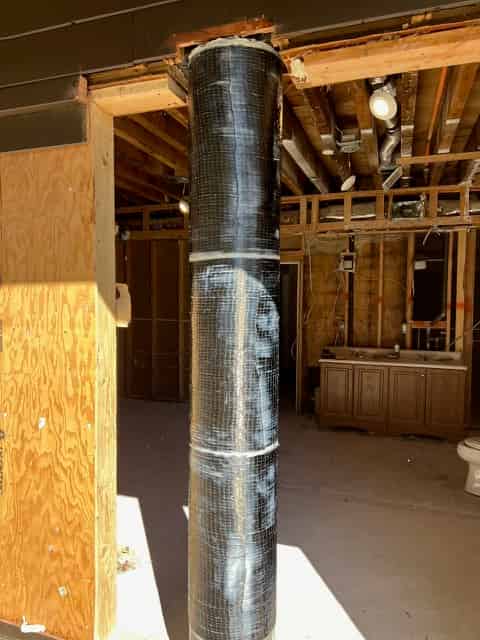
No meaningful mass. Externally bonded fiber reinforced polymer is a thin composite of high-strength fibers in a polymer matrix bonded to the existing surface. It adds tensile capacity, confinement, and ductility without the added dead load of a concrete or steel jacket, which is one of the reasons engineers specify it on existing buildings.
The structural engineer of record produces the design intent, members, demand, target capacity, and performance objective. The system manufacturer's in-house engineering then produces the application-specific drawings, fabric, orientation, layers, overlap, and anchorage. We bid and install to that package. We are the licensed applicator, not the design engineer.
FRP design follows ACI 440.2R, applied as part of an ASCE 41 seismic evaluation and retrofit or a code-triggered upgrade under the California Building Code. The Henkel and LOCTITE Tyfo system we install is covered by ICC-ES Evaluation Report ESR-2103, which documents tested properties, design assumptions, and conditions of use for the building official.
It depends on the scope, the areas being worked, and the project conditions. FRP retrofit is often phased and localized to specific members, which can allow portions of a building to remain in use. Occupancy, access, and phasing are coordinated with the engineer of record and the owner, and we note our assumptions in the written bid.
Industrial coatings
Resinous and epoxy floor systems
American-made resinous floors: return-to-service timing and why substrate preparation decides whether a floor lasts.
Return-to-service time depends on the system. Fast-cure polyaspartic and polyurea topcoats can return to service in hours rather than days, while standard epoxies cure over a longer window. We match the system to your downtime tolerance and confirm cure and return-to-service timing per the manufacturer's data sheets in the bid.
Skipping substrate prep is the fastest way to a failed floor. Before any coating goes down we profile the slab, repair spalled concrete, and fill control joints to create a sound, properly profiled base. The coating is only as durable as the bond beneath it, so we never skip this step.
A solid-color system is one uniform color: clean, bright, and economical. Flake (or broadcast) systems blend vinyl chips into the coating for a textured, hide-everything look that is popular in garages and showrooms. Quartz systems broadcast colored quartz aggregate for a heavier-duty, naturally slip-resistant surface used in wet and food-service areas. We match the system to how the floor looks and how hard it works.
Yes. Slip resistance is tuned by broadcasting aggregate (quartz, aluminum oxide, or polymer grit) into the system and choosing the right topcoat. We set the texture to the environment, balancing traction in wet or greasy areas against ease of cleaning, and we confirm the approach in the written bid.
Concrete can carry moisture vapor that will lift a coating not built for it. Where it is a concern we test the slab and, when needed, install a moisture-mitigation primer rated for the measured vapor emission before the system goes down. Catching it up front is far cheaper than recoating a failed floor.
A properly specified and installed resinous floor is measured in years to decades, not seasons. The exact life depends on the system, the traffic, and the chemical exposure it sees. High-wear topcoats can be refreshed without redoing the whole build-up, which extends the floor further.
Often, yes. We assess the existing floor (coating type, adhesion, and condition) and either prepare and recoat it or remove it down to sound substrate. Oil-stained, previously coated, and worn floors are common; the prep approach and any repairs are spelled out in the written bid.
Working with us
Bids, schedule, and how a job runs
Turnaround on a written bid and the path a project takes from engineer's drawings to documented handover.
It depends on the job. Before we put a number on it, we go over the drawings, the manufacturer does a material takeoff and quotes us the materials, and we walk the site to see the real conditions. That way the price we give you is one we can stand behind. The written, itemized bid covers materials, labor, schedule, and our assumptions. Because we run a small, non-union shop, we can also mobilize without a months-long lead time once a project is awarded.
Design intent comes in from the engineer of record, the manufacturer produces the application or system spec, and we issue a written, itemized bid. On award we mobilize, prepare the substrate, and install per the manufacturer's method, primer, fabric or body coat, saturant or topcoat, and anchorage where called for. We verify cure, document QA, and hand over with warranty paperwork where project conditions qualify.
Still have a question?
Send the drawings. Get a written, itemized bid.
Engineer's package or a coatings scope, we will read it, ask the right questions, and come back with materials, labor, schedule, and our assumptions in writing.